

Best of 2025: A first Grade 1 win for trainer Miguel Clement
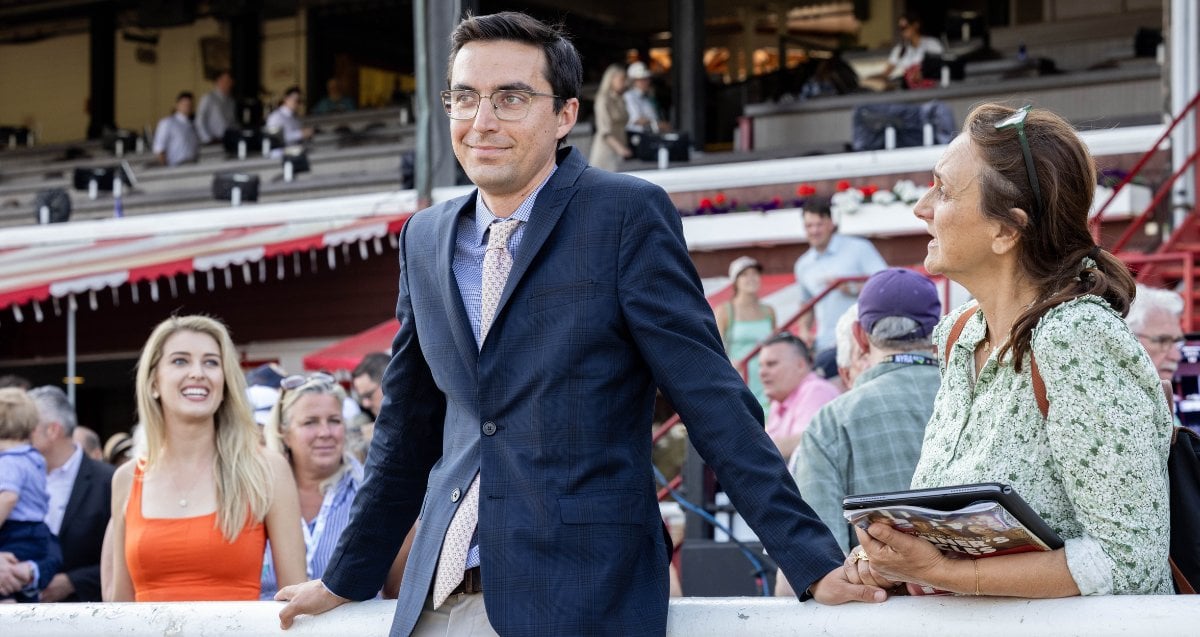
To celebrate a remarkable year of racing action on the New York Racing Association, Inc. (NYRA) circuit, the NYRA Press Office checked in with a selection of trainers, owners, jockeys and racing personalities to share their reflections on the memorable year.
In June, trainer Miguel Clement earned his first Grade 1 victory a short time after the untimely passing of his father Christophe, a stalwart conditioner in New York and winner of more than 2,500 races and $184 million in purses. In the months since, the Clement family has supported each other to carry on with Miguel at the helm.
With much of the same staff and clientele still a part of the operation, the stable has continued to prosper, posting 59 wins [19 of them stakes wins] from 302 starts with just over $7 million in total purses since May 31 [as of December 10]. Among them was stable star Deterministic, whose wins at Saratoga Race Course in the Grade 1 Resorts World Casino Manhattan on June 8 and Grade 1 FanDuel Fourstardave on August 2 marked the first at the top-level for Clement. Deterministic also won the Grade 2 Fort Marcy in May at Belmont at the Big A.
The 34-year-old trainer reflected on his first Grade 1 win, and stressed the importance of family both personally and professionally as his wife Acacia Clement, mother Valerie Clement and sister Charlotte Clement Collins provide invaluable support.
Q: Your first stakes victory came this summer at Saratoga with Deterministic in the Grade 1 Resorts World Casino Manhattan, a race your father won three times with Forbidden Apple [2001], Gio Ponti [2009] and Winchester [2010]. What do you remember most about that experience?
MC: “Without a doubt, the Manhattan was meaningful as the stable’s first Grade 1 win, and dad always loved that race. To get a big victory like that right after dad [passed], it was tough emotionally, but it was needed.
“There’s nothing like winning a big race at Saratoga. His three victories this year I think are enough to be considered for the Eclipse Award, but I am biased.
“I think we had taken away a little bit of his natural tactical speed. We finally said, ‘to heck with it,’ and let him use his speed instead of trying to rate him. He won the Virginia Derby and the Gotham, and showed a lot of ability from the get-go. We decided to put him more forward in his races, and he’s been very impressive. He had a great, strong campaign, he’s here with me at Payson Park, and I’m very much looking forward to next season. He’s a very good horse, and to me, I think he’s the best miler in the country.”
Q: As you reflect on this year, what are some other key milestones you and the team are proudest of?
MC: “As everyone knows, it’s been a very challenging year. Dad played a big role in all our lives, and had a larger-than-life personality. He is greatly missed, and fortunately the horses are running well, so they are a much-needed distraction. I thought we had a very strong season, and it’s really great they are running well. The stable needed it, the family needed it. The horses did more than their fair share.
“I was very proud of some of the older horses. It shows you that as long as you keep them sound, good things happen. 6-year-old Gal in a Rush won the Presque Isle Downs Masters, 6-year-old La Mehana won the [Grade 2] Glens Falls by eight [3/4] lengths, and 6-year-old Tawny Port won over $800,000 within five weeks without even winning a race. I think we all put a lot of emphasis on 2-year-olds, but longevity is the name of the game. Soundness is what matters, and to have a very good horse as an older horse is what we should all be aiming to do. The stable was able to have some great performances with older horses, and that was very rewarding.
“Breath Away really took it to another level in the second half of the year, and Ozara showed great consistency during Saratoga. I’m very proud of the 2-year-old stats as well, and we’ve won three graded stakes with 2-year-olds. All in all, the stable is very successful all across the board.”
Q: Juvenile prospects such as Bottas, Intricate Spirit and The Big Con showed their talent this year with graded stakes victories. What is your process of bringing young horses along from the time they enter the barn until they make their debut?
MC: “2-year-olds don’t lie, and they’re very straightforward. They tell you exactly how good they are from the get-go, and it’s just your job to make sure they’re experienced, they’re not immature, and they’re straight as an arrow. The straighter they are, the more you’ll win with 2-year-olds. Nine times out of 10, the difference between first, second and third is not about ability, but more about maturity and greenness. You just have to make sure they’re as experienced as they can be so that by the time race day comes, they know what is expected.
“Every day, you should have a goal to teach them something new. Whether it’s ponying, going to the gate, every little nuance. If you expose them to one new element, it’s a success.
“The overwhelming majority of years, we’ve had a lot of success with 2-year-olds. For whatever reason last year, we were slow with our 2-year-olds, so this year I put more emphasis on the 2-year-olds and we got it right. We had four 2-year-old maiden winners at Saratoga. We’re very lucky and I’m happy we bounced back from last year.”
Q: With all 19 of your stakes wins coming on turf or synthetic this year, what is it about these types of horses that makes them a good fit for your program?
MC: “Dad used to be upset when people would label him as a turf trainer. When he first came to America, they said he was a very good turf trainer for stamina. Then, during the age of Pure Sensation and Disco Partner, they said he was actually a turf sprint trainer. Then, it was just turf colts. It’s probably just a product of the type of horses we have. We have a strong presence of European horses in our outfit, and that’s probably part of it.
“I’d love to break the label, and I think about it often. Our percentage on dirt this year [26%] is higher than people think. But at the same time, a label is a positive since it means you’re doing something right. The horses have delivered more than we could have imagined.”
Q: You train for several owners who have had horses with the stable for many years, such as Robert Evans, Moyglare Stud Farm, West Point Thoroughbreds and Reeves Thoroughbred Racing, among others. How important is the continued support of long-term clients?
MC: “Without the ownership we have, this wouldn’t be possible. We are very fortunate that dad left us with both a phenomenal clientele, as well as a great team. It’s no fluke that the team has been winning big races for many years, and I just hope to keep the chance to continue doing the same.”
Q: Along with long-term clients, the barn has also maintained several key staff members for many years. Among them is Christophe Lorieul, who has been a stable assistant since 1994. How has the support of trusted staff helped during the stable’s transition?
MC: “The stable really stepped up, even in our worst moments of our life. Christophe Lorieul is a member of the family, and has been for many years. He shares the success and feels the frustrations of the lows just as much as we all do. It’s not often you have someone who is invested to the same depth and length as you, and willing to sacrifice as much as he has for the same cause as you. I’m very humbled by that, and the entire stable is better off by having him. He’s pure class and a very gifted horseman. I can’t speak highly enough of Christophe.”
Q: With two Grade 1s on your ledger and an additional 11 graded wins, what are some of your goals for next year and beyond?
MC: “I just want to keep doing better. It was a very strong season, but there’s many things I want to do. I want to get that first Breeders’ Cup win out of the way. I thought we had a poor showing this year, and we didn’t execute it as well as we would have hoped for, so that’s a major thing on the list. We just want to win more races. Why? Because we are competitive by nature, otherwise we wouldn’t be in this profession.”
Q: What role does family play in the stable’s success?
MC: “My wife was there for me through all of it. My sister and my mom sacrificed everything to try to find dad a cure, and my mother tried her best to be there at Saratoga this summer as many days as she could to show support for the stable. My sister redirected much of her work towards working on the finances of the stable so I could focus as much as I could on the horses. In that regard, my wife did the same.
“My family is a very big deal, maybe more so for me than any other outfit. They protect me, they help me, and they don’t get any recognition. The family put me in this position and they support me. A lot of the outreach and affection went towards me and not them, but it hit them as bad as me. So much of the credit goes to them.”
Q: What are some lessons or pieces of advice from your father that have stuck with you?
MC: “That it’s a very humbling game. You try to be as consistent as possible, which is tough in this profession because you deal with so many ups and downs and a lot of volatility. You just try to work as hard as possible. If you have a strong work ethic, that takes care of a lot of it.”