

Six-time Aqueduct stakes-winner Inherit the Gold still making his connections proud
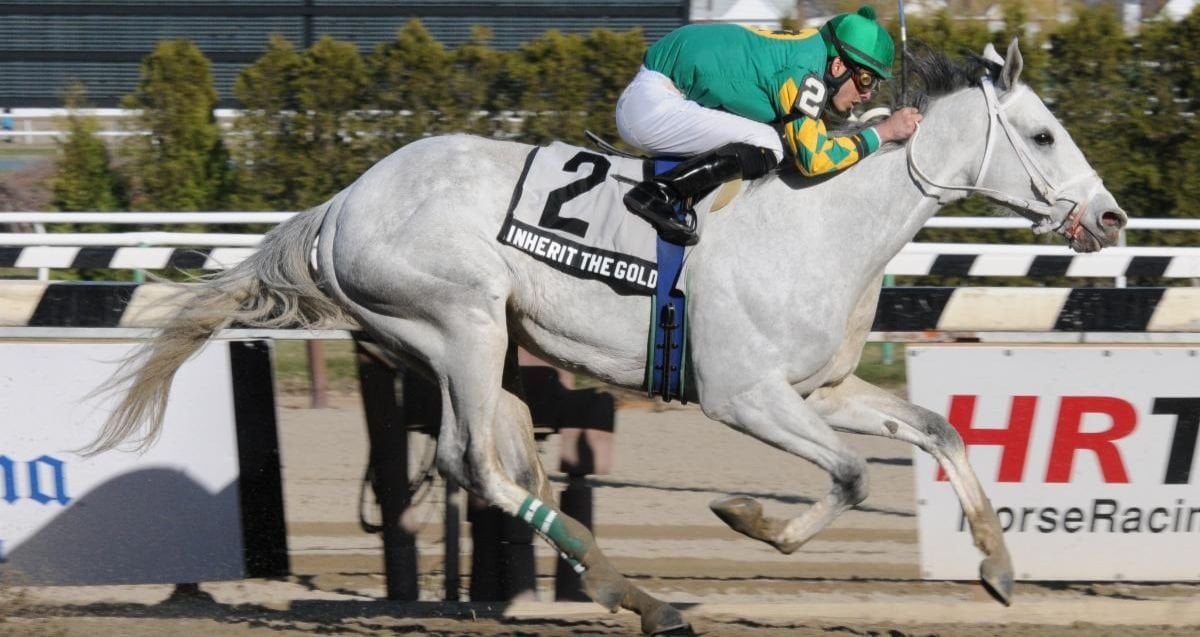
An old farmhouse that sits on Reynolds Road in Fort Edward, N.Y. is adorned with photos of the star athlete in the family. Portraits, paintings, trophies and mementos hang on the walls and sit atop the mantle. A scrapbook of newspaper clippings, press releases and photographs sits on the kitchen table, carefully cultivated and preserved with love. The star athlete in question, 20-year-old gelding Inherit the Gold, is not human, but might as well be to Jim and Susanne Hooper.
For one horse to win six stakes races in their career is quite the accomplishment, and for all of them to come at one racetrack lends itself to the expression “horses for courses.” The Hooper’s Inherit the Gold proved his affinity for Aqueduct Racetrack by doing just that from 2011-12.
Jim Hooper, who grew up in Evansville, I.N. and frequented Ellis Park in his youth, was in the Navy for about a decade, and went on to work as a consultant for several years after. During that time, his work took him around the country, and his love of horse racing grew as he visited as many racetracks as he could.
In his travels, Hooper met his wife, Susanne, and the two bonded over their shared love of horses. She owned a farm in Amsterdam, N.Y., about 30 miles southwest of Saratoga, and the two dreamed of one day moving somewhere bigger.
As fate would have it, Jim went on a golf outing in 1999 at a golf course in Fort Edward and noticed the large farm across the road was for sale. A year later, the Hoopers took the plunge and purchased the property, naming it Haven Oaks Farm and priding themselves on their personal relationships with each horse as they offered services in foaling, boarding and rehab, and partnerships in horses they have bred.
Among their early homebreds was a gray son of Gold Token, foaled out of the winning Personal Flag mare Melissa’s Sunshine in 2006. The foal was officially named Inherit the Gold as he was from one of the final crops by his sire, and was called “Harry” around the farm. The nickname is seemingly a play on the “Inherit” part of his name, but Susanne said it came from an endearing trait the colt presented at birth.
“We had a partner on him and she came to see him when he was a baby,” Susanne said. “He was bay and he had these circles around his eyes, and she said we should either call him ‘Specs’ or ‘Harry Potter’ because it looks like he’s wearing glasses. I said, ‘We better call him Harry, because in a few months he’ll be gray and it won’t look like he’s wearing glasses anymore.’ He got gray pretty quick.”
Inherit the Gold, who was co-owned by Glas-Tipp Stable and later Ochre House Stable, made it to the racetrack in 2009, and started his career in the care of trainer Charlie Baker. He graduated at second asking that March at the Big A, and went on to hit the board in four of his next five outings before his career and the Hoopers’ lives took an unexpected turn in 2010.
With the recession of 2008 taking its toll, Hooper made the difficult decision to sell all but one of his five racehorses, with Inherit the Gold left as his lone color-bearer. Hooper concluded it would be most cost-effective to take out his trainer’s license and train Inherit the Gold himself in a small outfit.
“We brought home all the horses and sold them – except for Harry,” Jim Hooper said. “We knew how good he was going to be, and I told Charlie I felt terrible to take the horse, but we brought him home, I decided to start training him, and the rest is history.”
Jim was now the trainer of an inexperienced yet promising racehorse, and began his career in an unconventional and unexpected way, but it would not take long for him to find success. Inherit the Gold was Hooper’s first starter, and won a state-bred allowance by one length in October 2010 at Belmont Park, a sign of the prosperity that lay ahead.
“We had been training at the Oklahoma in Saratoga, and I put him in the trailer myself and drove him to Belmont,” said Hooper, who trained about five horses at the time. “I remember thinking, ‘this has got to be one of the craziest things a person has ever done.’ He won that race fairly easy, and I knew this horse was really, really good.”
His next start yielded a three-quarter-length third to subsequent multiple stakes-winner Saginaw, then trained by Chad Brown, in a second-level optional claiming tilt at Aqueduct before launching a five-race win streak that defined his career.
“He got beat in that second race, and at the time, I had no idea who beat me. I was thinking, ‘maybe this horse isn’t as good as I thought he was.’ But I remember Chad Brown telling me after the race not to worry about it because his horse was going to be a great horse, and he only beat me by about a foot,” Hooper said, with a laugh.
The gelding’s win streak began with a pair of optional claiming wins under regular pilot Eddie Castro, including a three-length romp in January 2011 that yielded a 100 Beyer Speed Figure, a performance that was convincing enough for Hooper to try him in stakes company. He won two state-bred stakes at Aqueduct – defeating Saginaw in the Mr. International ahead of the Kings Point – before stepping up to graded company for the first time in the Grade 3 Excelsior that April.
In just his 18th start as a trainer, Hooper paced the apron of Aqueduct as his prized homebred stalked just off the pace under Castro in the nine-furlong route and made a bid at the quarter pole to take a four-length lead at the stretch call and widen his margin down the lane, winning geared down by 6 1/4 lengths in a final time of 1:50.34. The nerves soon turned to joy for Hooper, who etched the much sought-after title of “graded stakes-winning trainer” onto his resume just six months into his career.
“It was a fairy tale,” Hooper said. “Every day going to the track leading up to the race, you’re a little more nervous. Then he won easy. He just blew them away in the last quarter, and it was the best race of his career. We just couldn’t believe it. I knew he had it won when he made that move at the quarter pole.”
For Hooper, perhaps the most memorable part of Inherit the Gold’s Excelsior win was the reaction of the Aqueduct regulars, who had watched Inherit the Gold blossom over the winter to become a graded stakes winner.
“Everybody knew him,” he said. “You had this gray horse that was running every two or three weeks and just kept winning, and it was a lot of fun.”
Inherit the Gold went on to win three more stakes at the Big A, taking the 2011 Thunder Rumble division of the New York Stallion Stakes Series, the 2012 Haynesfield and the 2012 Listed Action. The latter proved his penultimate start before retiring from racing at age 6 with a record of 25-10-5-3 that included three additional stakes placings and earnings of $478,985. According to statistics provided by Equibase dating to 1976, he is one of 16 horses to win six or more stakes races at Aqueduct, his six wins placing him three back of the Aqueduct leader in stakes wins, Lottsa Talc.
Hooper said both he and Inherit the Gold share an affinity for Aqueduct.
“I don’t really know what it was about Aqueduct,” Hooper said. “The cold never bothered him. I don’t think he disliked the summer, he just had bad luck in his summer races. You need winter racing. Having racing year-round is critical.”
Inherit the Gold returned to Haven Oaks to retire, and lives as the patriarch in a herd of five turned out in a large paddock. Haven Oaks is also the base for local therapy provider Adirondack Equine Assisted Psychotherapy, where a handful of horses on the farm assist in their programs. The Hoopers take care of all of the horses, both their breeding band and the therapy horses, and founded the Inherit the Gold Foundation to help retire horses to be used in therapy or another discipline, and to provide scholarships for uninsured or underinsured individuals for Equine Assisted Psychotherapy.
While Inherit the Gold proved too spirited to be an official therapy horse, Susanne said clients love spending time with him and often make a connection with the charismatic herd leader.
“The clients go down and visit with him, so even though we can’t make him a therapy horse, they go to the gate and he comes and blesses them with his presence,” she said, with a laugh. “He always comes over and does a little drive-by therapy.”
As he sat at the table looking over the pages of the scrapbook, the memories are still fresh for Jim, who started a handful of horses since Inherit the Gold retired, his most recent being homebred Hey Toby at Saratoga Race Course in 2023. The lifestyle still calls to him, and the upcoming reopening of Saratoga’s Oklahoma training track for the season on April 20 has him dreaming big once again.
“I’m going back in April,” he said. “I love training, but there’s a lot of pressure. It’s every morning at 5 o’clock, I don’t like to leave my horses alone when I’m training them, so I practically live at the barn. I am trying to see at 70-years-old, should I do this? It’s in your blood, and I’m pretty sure I’m going to do it. I’m happy to win any race because you put a lot of work into it. You always want to see if you have another big horse out there. Not many horses can do what Harry did – from the day he was born, there was something about him.”
*
The Inherit the Gold Foundation is a 501(c)3 non-profit organization that seeks to provide grant money for uninsured or underinsured individuals to participate in mental health therapy, and to help assure racehorses a safe and loving home after retirement from racing. For more information, visit https://www.inheritthegold.org/.
